
- 27 July 2026
- Back to overview
-
TOGU
70 Years of TOGU – Seven Decades of Ball Manufacturing by Lake Chiemsee
- 1956 – The First Seamless Play Ball
- 1964 – The Birth of the Bouncing Ball
- 1970 – The Air-Filled Medicine Ball
- 1983 – From Play Ball to Exercise Ball
- 1985 – The Moonhopper Bounces Around the World
- 1993 – Redondo®: An Enduring Product Brand
- 1995 – The Dynair Ballkissen® Reinvents Balance
- 1998 – ABS®: An Anti-Burst Material Born from Responsibility
- 2000 – Powerball® Extreme ABS® and Aero-Step® for Elite Sports
- 2008 – TOGU Jumper® and Brasil® Workout
- 2013 – The Balanza®-Series: Ball Meets Wood
- 2020 – The Moonhopper® Makes Its Television Comeback
- 2024 – PAB®: Power and Balance belong together
- 2026 – 70 Years of passion from Prien
- About TOGU
It begins with a simple observation and an uncomfortable question: Why do children’s balls so often burst at the seams? In 1956, the brothers Toni and Gust Obermaier find the answer in Prien-Bachham by Lake Chiemsee – and manufacture the first seamless play ball moulded in one piece. What began as a technical improvement marks the start of a seventy-year story. Seven decades in which a children’s toy became a principle of movement – for children, elite athletes, therapists and everyone in between.

1956 – The First Seamless Play Ball
Demand for high-quality children’s balls was enormous in the post-war years. While other manufacturers assembled balls from several sections that would eventually tear at the seams, the Obermaier brothers took a different approach: they developed a process for manufacturing a ball in one piece. Seamless. Robust. Durable. The first TOGU ball was therefore less a product than a statement – about quality, craftsmanship and manufacturing thought through to the very last detail. A principle that continues to guide TOGU today.
1964 – The Birth of the Bouncing Ball
Sometimes all it takes to invent a new product category is watching children at play. At a harbour, children were playing with fenders – the cylindrical buffers used to protect boats from impacts at the dock. The children bounced around on them, but the fenders were hard and uncomfortable. The Obermaiers took the idea further: What if the material were softer, more elastic and safe enough to sit and bounce on? This is how the bouncing ball was created in Prien-Bachham in 1964 – the model for many bouncing balls now found in children’s rooms and sports halls around the world.

1970 – The Air-Filled Medicine Ball
Six years later, TOGU launches the first air-filled medicine ball. While conventional medicine balls had previously been heavy, hard and difficult to grip, the company in Prien introduces an air-filled version with defined elasticity. The ball is easier to handle and makes training more versatile. To this day, the classic medicine ball remains a popular piece of equipment in sports clubs, rehabilitation centres and fitness studios – and an early indication that TOGU does not simply make toys or sports equipment, but tools for movement.
1983 – From Play Ball to Exercise Ball
The journey from children’s toy to a standard piece of physiotherapy equipment was not a marketing idea, but the result of a real-life observation: by removing the handles that children used to hold on to, the bouncing ball became a large exercise ball. Physiotherapists had begun using the toy for functional exercises. TOGU responded by adapting its sizes, material thickness and load capacity – turning an idea from physiotherapy into a series-produced product. Active sitting, back training, rehabilitation: what is now standard in every practice began here.

1985 – The Moonhopper Bounces Around the World
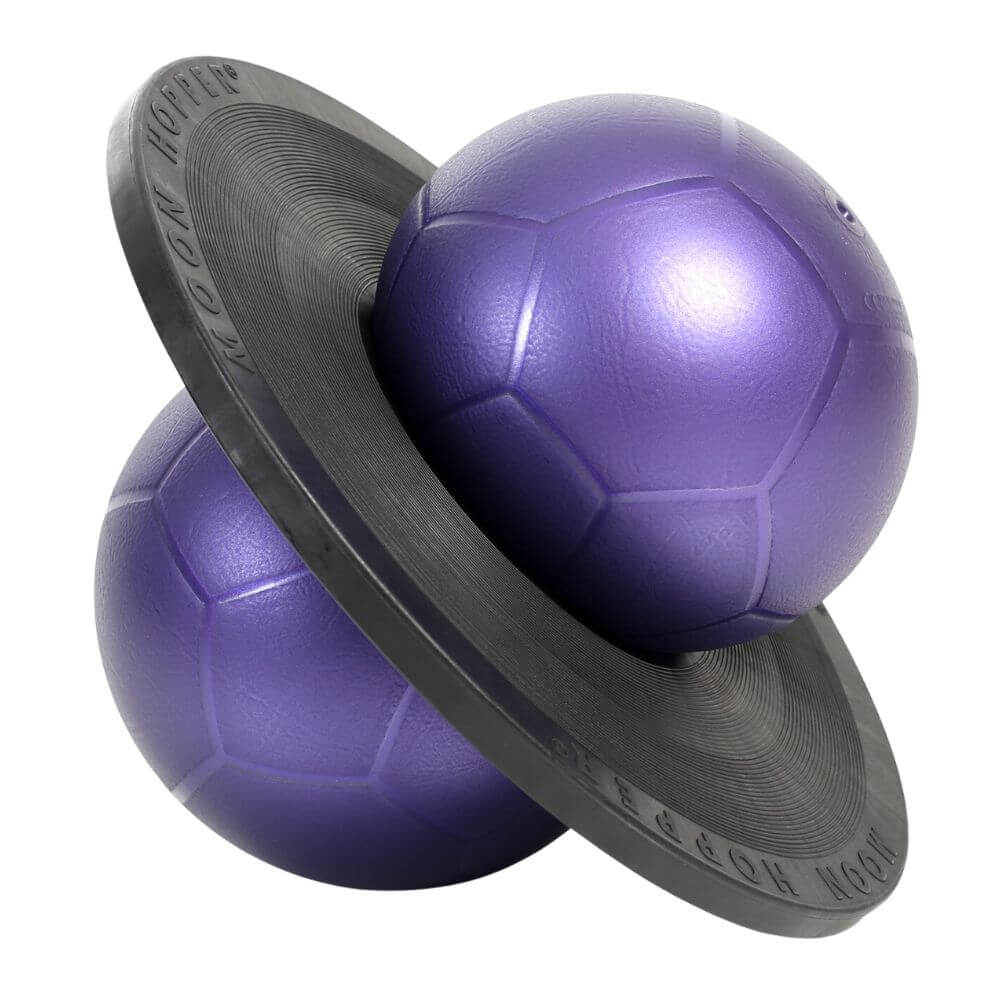
Two years later, the bouncing ball comes of age: the Moonhopper combines fun and robust engineering and becomes a global cult favourite. Generations of children know it – as do many adults, who use it as a training device for coordination, endurance and, as a welcome side effect, a good mood. The Moonhopper exemplifies what makes TOGU special: products that last a lifetime and remain relevant for decades.
1993 – Redondo®: An Enduring Product Brand
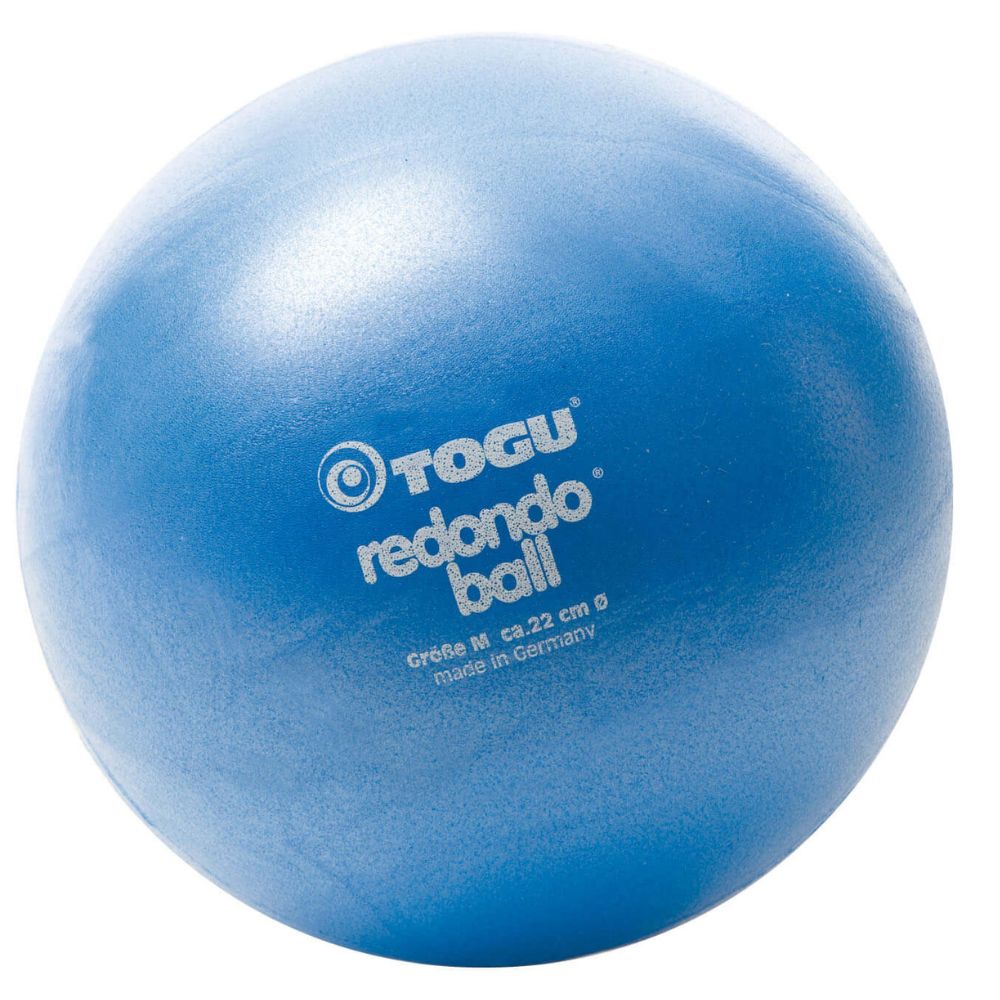
Not every exercise requires a large ball. Sometimes it is the small, soft ball held in the hand or placed between the knees that provides the crucial stimulus. In 1993, TOGU launches the Redondo® Ball – a lightweight, air-filled ball with a soft surface that delivers benefits where large training devices reach their limits: in precise movement tasks and exercises performed on the floor or while seated.
Redondo quickly becomes a favourite tool in Pilates studios, physiotherapy practices and back exercise classes. Used as resistance between the knees, as neck support or as a target for coordination tasks, the small ball fits into almost any training session. Over the years, the original develops into an entire Redondo® family featuring different sizes and levels of firmness. More than three decades after its launch, Redondo remains one of the defining tools of modern bodywork – proof that a good product idea is not a passing trend, but can have an impact for decades.
1995 – The Dynair Ballkissen® Reinvents Balance
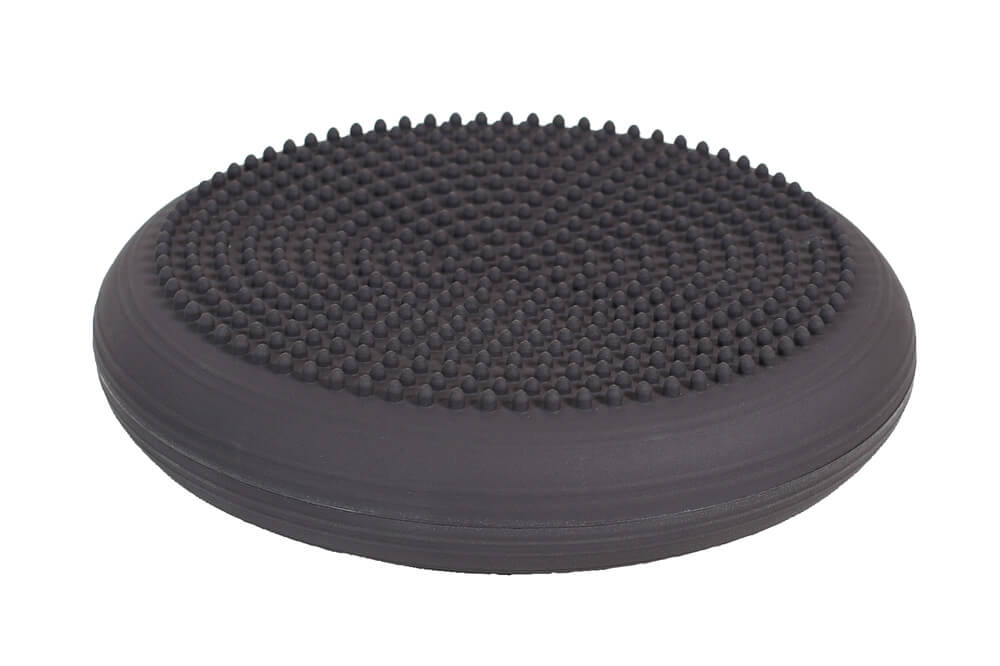
In the early 1990s, a practical question arises in Prien-Bachham: the exercise ball is an excellent training device – but it takes up space. How can its benefits be retained in a more compact format? This idea leads to the first air-filled balance cushion under the Dynair Ballkissen® brand – developed to its logical conclusion and manufactured in Prien-Bachham by Lake Chiemsee. Originally conceived as a space-saving alternative, it soon becomes a training device in its own right and is now standard equipment in practices, studios and offices. Active sitting has found its tool.

1998 – ABS®: An Anti-Burst Material Born from Responsibility
One of the most important material developments in TOGU’s history has a specific trigger. At a trade fair, Toni Obermaier watches a weightlifter lying on an exercise ball with a heavy additional load. The sight does not inspire admiration, but a clear realisation: What if this ball bursts? Back in Prien-Bachham, development begins on the anti-burst material ABS® – a material compound that prevents the ball from bursting suddenly. If damaged, the ball loses air only slowly. A safety promise that changes the entire industry. To this day, ABS® stands for an exercise ball guaranteed not to burst suddenly – and expresses a clear principle: anyone who enables movement bears responsibility for the people who move.

2000 – Powerball® Extreme ABS® and Aero-Step® for Elite Sports
At the turn of the millennium, more and more TOGU products also find their way into elite sports. The Powerball® Extreme ABS® is a training device designed to withstand the demands of athletic training and rehabilitation in elite sport – highly resilient and uncompromisingly safe. At the same time, the Aero-Step® is created: an air-filled training platform for dynamic balance training. Both products demonstrate that TOGU offers not only breadth, but also depth – for rehabilitation in clinical practice as well as for athletic and fitness training.

2008 – TOGU Jumper® and Brasil® Workout
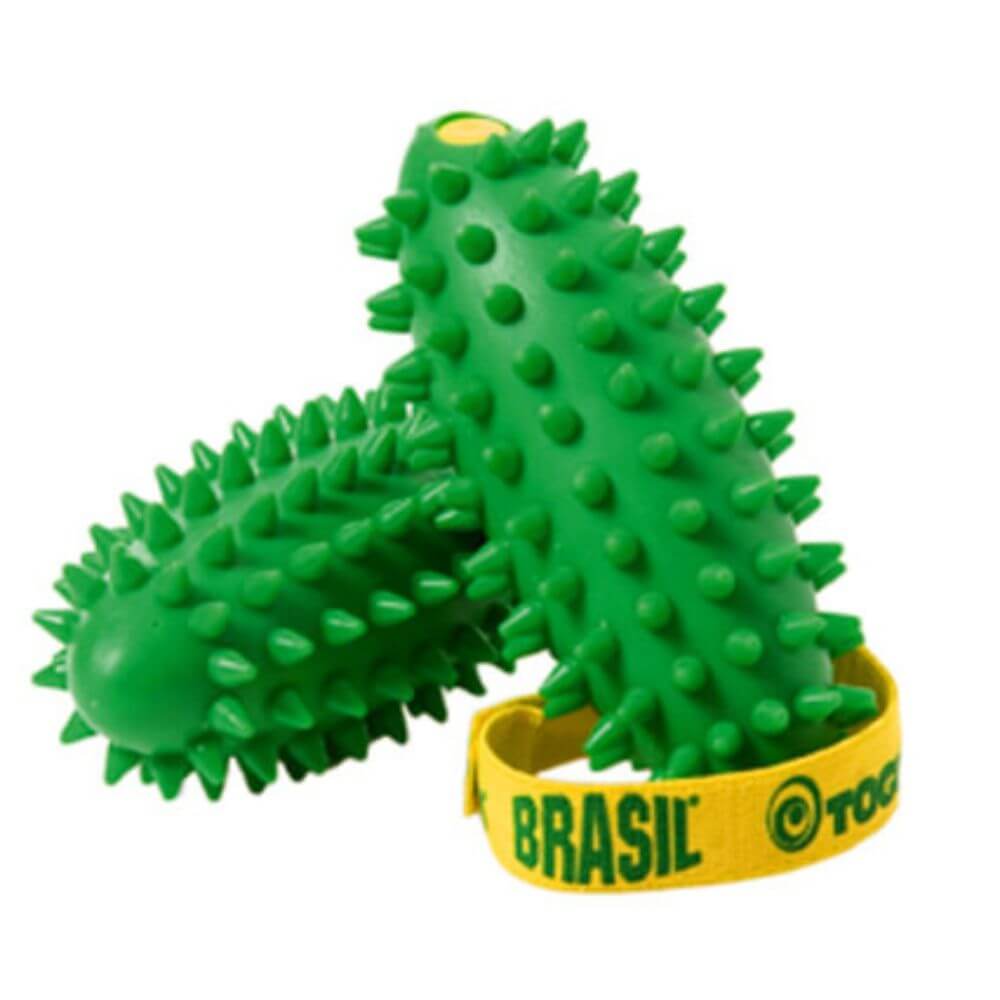
Movement with a concept: this is why TOGU focuses on combining powerful training equipment with a powerful method in 2008. The TOGU Jumper® brings balance training into fitness studios – half a ball, a stable base and countless exercise options. At the same time, the Brasil® Workout is created: training with compact hand weights that use subtle vibrations to activate the deep muscles and train core stability. Two products, two movement concepts – one shared principle: even the best equipment is of little use without the right training.

2013 – The Balanza®-Series: Ball Meets Wood
When two seemingly incompatible materials come together, the result is often the smarter solution. The Balanza® series combines an air-filled ball with a wooden platform – creating an entirely new training geometry. Stable enough for controlled exercises, yet unstable enough to provide genuine proprioceptive stimuli. Balanza is not a cosmetic variation of an existing product, but a training philosophy in its own right: balance can be trained when it is given the right platform.

2020 – The Moonhopper® Makes Its Television Comeback
Sometimes old friends return. In the ARD television programme ‘Klein gegen Groß’, the Moonhopper Sport takes centre stage in a challenge – and viewers discover that a product dating from 1985 has lost none of its fascination in 2020. For TOGU, this is more than a PR moment: it proves that products built consistently for quality know no generational boundaries.

2024 – PAB®: Power and Balance belong together
Strength without coordination is energy that dissipates. Coordination without strength has no impact. With PAB® – Power and Balance, TOGU launches a product line in 2024 that brings the two together. Strength development and balance training in a single tool – consistently developed from 70 years of movement expertise.
2026 – 70 Years of passion from Prien
Today, TOGU is run by the third generation – at the same site in Prien-Bachham by Lake Chiemsee where it all began in 1956. Fifty employees work here across every stage: from the initial idea, design and mould making to production and distribution through all levels of trade. Around 90 per cent of the range available at www.togu.de is ‘Made in Germany’ – or, more precisely, ‘Made in Prien-Bachham’.

„At TOGU, ‘Made in Germany’ is not a label, but a manufacturing principle. Anyone with an idea can have it sketched, designed, moulded, produced, inspected and packaged at the same location. This vertical range of manufacture explains why a company by Lake Chiemsee repeatedly creates products that define a category – from the seamless play ball of 1956 to the present day.

About TOGU
TOGU GmbH has been based in Prien-Bachham by Lake Chiemsee since 1956 and is one of the world’s leading manufacturers of balls and training equipment for sport, therapy and leisure. The third-generation family business currently employs 50 people. Around 90 per cent of the product range is developed and manufactured at the Prien-Bachham site. Find out more at www.togu.de.

-
 Equestrian fitness is much more than just a traditional full-body workoutRider fitness is much more than a traditional full-body workout. This highly effective fitness course, specifically designed to meet the needs of ride...Mehr lesen
 -
 Neurofitness: Why Training Your Brain May Be One of the Smartest Investments in Healthy AgingWhen people think about fitness, they usually focus on muscles, strength, or endurance. But every movement we make starts somewhere else first: the br...Mehr lesen
 -
 Balance Can Be Trained – And It’s More Important Than EverWhen people think of balance training, they often associate it with older adults or rehabilitation programs. In reality, balance is a fundamental comp...Mehr lesen
 -
 Why Muscle Strength Is a Key Biomarker for Healthy AgingFor many years, blood pressure and cholesterol levels were considered some of the most important indicators of overall health. Today, however, researc...Mehr lesen
 -
 Longevity Starts with Movement – Why Strength and Balance Are Essential for Healthy AgingMore and more people want not only to live longer but also to remain healthy, active, and independent for as long as possible. This is the core idea b...Mehr lesen
 -
 A day full of activity, learning, and hands-on experienceSpecialist Workshop: Movement Competence in Canine Therapy – Holistic Concepts for Rehabilitation, Training, and Sustainable Performance on 29.04.2026Mehr lesen
 -
 TOGU Medicine Ball Classic: The Athletic Tool for athletesMore power, more control – why the TOGU Medicine Ball is a must-have in athletic training You train hard. You want results. And you know that the righ...Mehr lesen
 -
 Unter der Lupe: TOGU® Brasil - mehr als nur ein FitnessbegleiterHeute testen wir für Euch die TOGU® Brasil. Ihr kennt diese kleinen stacheligen Kiwi-großen, mit Gewicht gefüllten Dinger vielleicht aus dem Fitness-B...Mehr lesen
 -
 TOGU: Moving Together for Health Day 2026 – Inspiration, exercise, and powerful motivation for an active lifestyleMovement connects, inspires, and creates new energy – that is exactly what the TOGU Together for Healthy Movement Day 2026 is all about on Saturday, O...Mehr lesen
 -
 TOGU at therapie MÜNCHEN 2026The therapy MÜNCHEN 2026 brings together the therapy industry from Southern Germany, Austria and Switzerland on 19 and 20 June 2026 and sets important...Mehr lesen
 -
 TOGU Trainings-Charts – inspiration for your workoutWho doesn’t know this? You plan to train regularly – but in everyday life, orientation is often missing. Which exercises fit which goal? How do I comb...Mehr lesen
 -
 TOGU Tai Chi Ball – Fluid Movement and Inner BalanceThe TOGU Tai Chi Ball is more than just a training device – it becomes a gentle point of connection between your hands. With its soft shape, it promot...Mehr lesen