
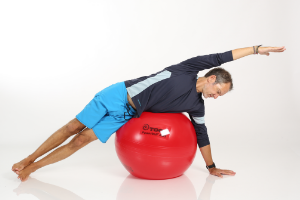
- Which muscles stabilize the knee?
- Knee instability – What are the symptoms?
- What causes can lead to knee instability?
- How can knee rehabilitation help?
- Knee rehabilitation with the Balanza Vario from TOGU
- The Balanza Vario in practice – A field report
- Our TOGU experts advise:
- These products from TOGU might interest you:
Knee stability is important because the knee joint is a heavily loaded joint in the human body. It is essential for many movements in daily life as well as for sports activities. Our blog article is about the important topic of knee stability and rehabilitation after an injury or surgery.
We explain which muscles stabilize the knee and what symptoms may indicate knee instability. In addition, a patient shares his experience with the Balanza Vario, a training device used for knee rehabilitation.
Which muscles stabilize the knee?
There are a number of muscles that stabilize the knee. These include:
- Quadriceps muscles: These are the muscles on the front of the thigh that extend the knee joint and stabilize the joint in full extension.
- Hamstring muscles: These are the muscles on the back of the thigh that flex the knee joint and play an important role in stabilizing the knee.
- Medial and lateral thigh muscles: These muscles are located on the inside and outside of the thigh and help stabilize the knee joint.
- Gastrocnemius muscles: These are the calf muscles that stabilize the knee, especially during activities that require bending the knee.
- Popliteus muscles: This is a small muscle located at the back of the knee that helps stabilize the knee joint.
A combination of all these muscles work together to stabilize and protect the knee joint.
Knee instability – What are the symptoms?
Knee instability can be caused by a variety of factors, including weakness or dysfunction of the stabilizing and inter-joint muscles or due to injury or overuse.
Symptoms of an unstable knee can vary and include a feeling of instability or wobbliness in the knee, knee pain, especially during movements that require bending or rotating the knee. Symptoms of knee osteoarthritis can also include swelling or stiffness of the joint and limited range of motion, which can result in an increased risk of injury, pain and instability, and a reduction in athletic performance.
When these symptoms occur, it is important to consult a physician or physical therapist to determine the cause of the instability and plan appropriate treatment. An accurate diagnosis can help determine the cause of the instability and plan the appropriate treatment to relieve symptoms and restore knee stability.
What causes can lead to knee instability?
Knee instability can be caused by various factors, including injuries such as cruciate ligament tears, meniscus damage or cartilage damage, but also degenerative diseases such as arthritis. Congenital deformities or muscular imbalances can also lead to knee instability. An accurate diagnosis by a physician or physiotherapist is therefore important to identify the cause of the instability and to initiate targeted rehabilitation.
How can knee rehabilitation help?
Targeted knee rehabilitation can help restore or improve knee stability. Specific training can strengthen the affected muscles and tendons to stabilize the knee joint, preventing injury. In addition, rehabilitation can help restore knee joint mobility, reduce pain and build muscle.
Rehabilitation after a knee injury is usually done in close collaboration with a physical therapist. The latter creates an individual training plan that is adapted to the needs and progress of the rehabilitation. Exercises are used that are specifically aimed at strengthening the affected muscles. Strengthening exercises as well as exercises to improve coordination and balance can be used.
Knee rehabilitation with the Balanza Vario from TOGU
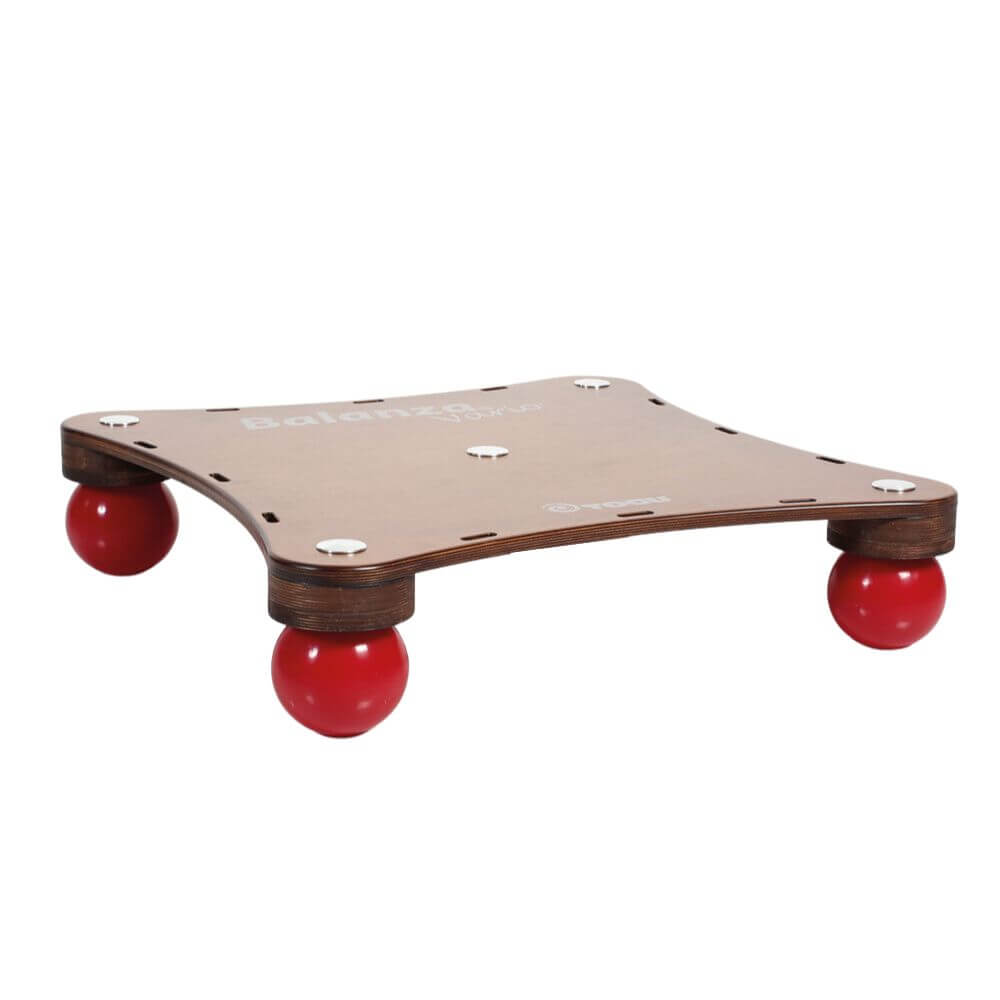
The Balanza Vario is a special training device that is specifically used for stabilization training in rehabilitation. It consists of an unstable standing surface with six pick-up points to which various elements such as foam wedges or ball cushions can be attached. These elements increase the instability of the standing surface and require the user to constantly adjust his balance.
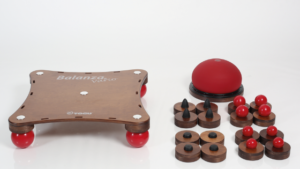
Training on the Balanza Vario can specifically improve the stability of the knee joint, as the instability of the standing surface challenges the muscles and tendons used and stimulates them to activate and strengthen. The difficulty of the workout can be adjusted as needed by using different elements or increasing the intensity of the workout.
The Balanza Vario is suitable for use in rehabilitation after a knee injury as well as for preventing injuries and improving general stability and coordination. It is recommended by many physiotherapists and trainers and is also used in physiotherapy practices and in the gym.
The Balanza Vario in practice – A field report
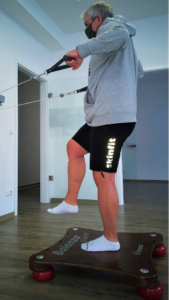
The company TOGU kindly provided me with a Balanza Vario for rehabilitation after my knee surgery. The Balanza Vario is the ideal training device for balance, coordination and strength building in knee rehabilitation. Due to the instability and the resulting dynamic standing surface, I had to continuously counteract and balance the movements with my legs, which is particularly important for stabilizing the knee.
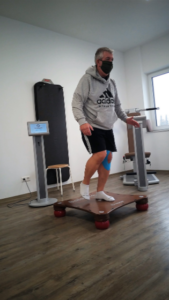
The six pick-up points underneath the Balanza Vario allow a varied combination of the elements supplied, so that an increase in training intensity is easily possible as rehabilitation progresses. The muscles that are important for knee stability are specifically addressed when training with the Balanza Vario.
In the first few hours, the elements were chosen so that I only had to deal with slight instability during my exercises. The longer the rehab lasted, the more the physiotherapists increased the instability and thus increased the demands on me (or on my operated knee).
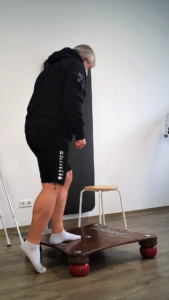
Das Balanza Vario wurde von den Physiotherapeuten für einbeiniges Stabilisationstraining für das Knie, das Wiedererlernen des Treppensteigens oder Gleichgewichtsübungen in Verbindung mit Core-Training verwendet, um die Muskeln, die für die Stabilität des Knies wichtig sind, gezielt zu trainieren und die Knierehabilitation zu optimieren.
Our TOGU experts advise:
“An important tip for successful knee rehabilitation is to take your time and be patient. A quick recovery is rarely the case and can even lead to an aggravation of the injury. It is important to stick to the rehabilitation plan set up by the doctors and physical therapists and undergo the treatments regularly.
One should also pay attention to one’s own body language and observe the load limits of the knee joint in order to avoid overloading. A balanced diet and adequate sleep are equally important to support the healing process.”
Our expert Markus Kiock, Fitnesstrainer
These products from TOGU might interest you:

-
 Bewegungsspiele für drinnen: So toben Kinder fröhlich durch den HerbstHalb fünf, draußen nieselt es, und im Wohnzimmer klettert jemand zum dritten Mal über die Sofalehne. Mit der Zeitumstellung am 25. Oktober wird es noch früher dunkel, und der Spielplatz rückt für viele Familien in die Ferne. Die Energie der Kinder bleibt. Sie braucht nur einen neuen Ort.Mehr lesen
 -
 Equestrian fitness is much more than just a traditional full-body workoutRider fitness is much more than a traditional full-body workout. This highly effective fitness course, specifically designed to meet the needs of riders, focuses precisely on the areas where stability, mobility and subtle aids in the saddle originate. Instead of conventional one-size-fits-all workouts, the focus is on targeted exercises for the shoulder girdle, back and deep core muscles, pelvic floor, diaphragm and respiratory muscles, as well as the stabilising muscles around the pelvis and hips.Mehr lesen
 -
 70 Years of TOGU – Seven Decades of Ball Manufacturing by Lake ChiemseeHow two brothers in Prien-Bachham by Lake Chiemsee developed the first seamless play ball in 1956 – and turned it into a family business that is now run by the third generation and inspires movement around the world.Mehr lesen
 -
 Neurofitness: Why Training Your Brain May Be One of the Smartest Investments in Healthy AgingWhen people think about fitness, they usually focus on muscles, strength, or endurance. But every movement we make starts somewhere else first: the brain.Mehr lesen
 -
 Balance Can Be Trained – And It’s More Important Than EverWhen people think of balance training, they often associate it with older adults or rehabilitation programs. In reality, balance is a fundamental component of nearly every movement we make—regardless of age.Mehr lesen
 -
 Why Muscle Strength Is a Key Biomarker for Healthy AgingFor many years, blood pressure and cholesterol levels were considered some of the most important indicators of overall health. Today, however, research is increasingly highlighting another powerful predictor of healthy aging: muscle strength.Mehr lesen
 -
 Longevity Starts with Movement – Why Strength and Balance Are Essential for Healthy AgingMore and more people want not only to live longer but also to remain healthy, active, and independent for as long as possible. This is the core idea behind longevity: it is not just about extending lifespan, but about increasing our healthspan—the years in which we maintain physical and mental well-being.Mehr lesen
 -
 A day full of activity, learning, and hands-on experienceSpecialist Workshop: Movement Competence in Canine Therapy – Holistic Concepts for Rehabilitation, Training, and Sustainable Performance on 29.04.2026Mehr lesen
 -
 TOGU Medicine Ball Classic: The Athletic Tool for athletesMore power, more control – why the TOGU Medicine Ball is a must-have in athletic training You train hard. You want results. And you know that the right tools make all the difference. The TOGU Medicine Ball Klassik is no nostalgic relic from the gym class era – it's one of the most effective pieces of equipment for explosive strength training, coordination, and functional athleticism.Mehr lesen
 -
 Unter der Lupe: TOGU® Brasil - mehr als nur ein FitnessbegleiterHeute testen wir für Euch die TOGU® Brasil. Ihr kennt diese kleinen stacheligen Kiwi-großen, mit Gewicht gefüllten Dinger vielleicht aus dem Fitness-Bereich oder aus dem Rückentraining. Aber diese kleinen Brasil lassen sich auch wunderbar in der Psychomotorik einsetzten, das möchten wir Euch heute gerne aufzeigen.Mehr lesen
 -
 TOGU: Moving Together for Health Day 2026 – Inspiration, exercise, and powerful motivation for an active lifestyleMovement connects, inspires, and creates new energy – that is exactly what the TOGU Together for Healthy Movement Day 2026 is all about on Saturday, October 17, 2026 in the Priental Hall in Aschau im Chiemgau.Mehr lesen
 -
 TOGU at therapie MÜNCHEN 2026The therapy MÜNCHEN 2026 brings together the therapy industry from Southern Germany, Austria and Switzerland on 19 and 20 June 2026 and sets important impulses for practice, training and rehabilitation.Mehr lesen