
Run longer, faster and healthier through stabilization training
Runners run. The name says it all.
But it is not only running that needs to be learned, the entire musculoskeletal system is involved. This requires a lot of muscles that should be trained. Stabilization and mobilization are important for runners.
Stabilizing training, the basic component of strength and endurance training, helps to train muscle groups that control and absorb the forces that affect the joints and body when running. It provides a better and more efficient running style, protects against injuries, allows you to run longer, faster and healthier.
Stabitraining strengthens the deeper lying muscle groups, thereby improving the sensomotoric abilities, i.e. the control of the brain to the muscles and the tendons and ligaments are strengthened.
There is a variety of exercises that serve to stabilize. Mostly the core – the middle of the body – is worked on. Also important for runners are the ankle, knee and back, because this is where most of the forces are applied during running.
Stabilization exercises can be made more difficult by choosing a shaky surface. A rolled up towel, a balance cushion or a balance board can be used here. There are countless exercises and variations that you can do – just try out what kind of exercises you enjoy. Because an exercise Stabi is better than none – and if you get a taste for it, Stabitraining is fun too!
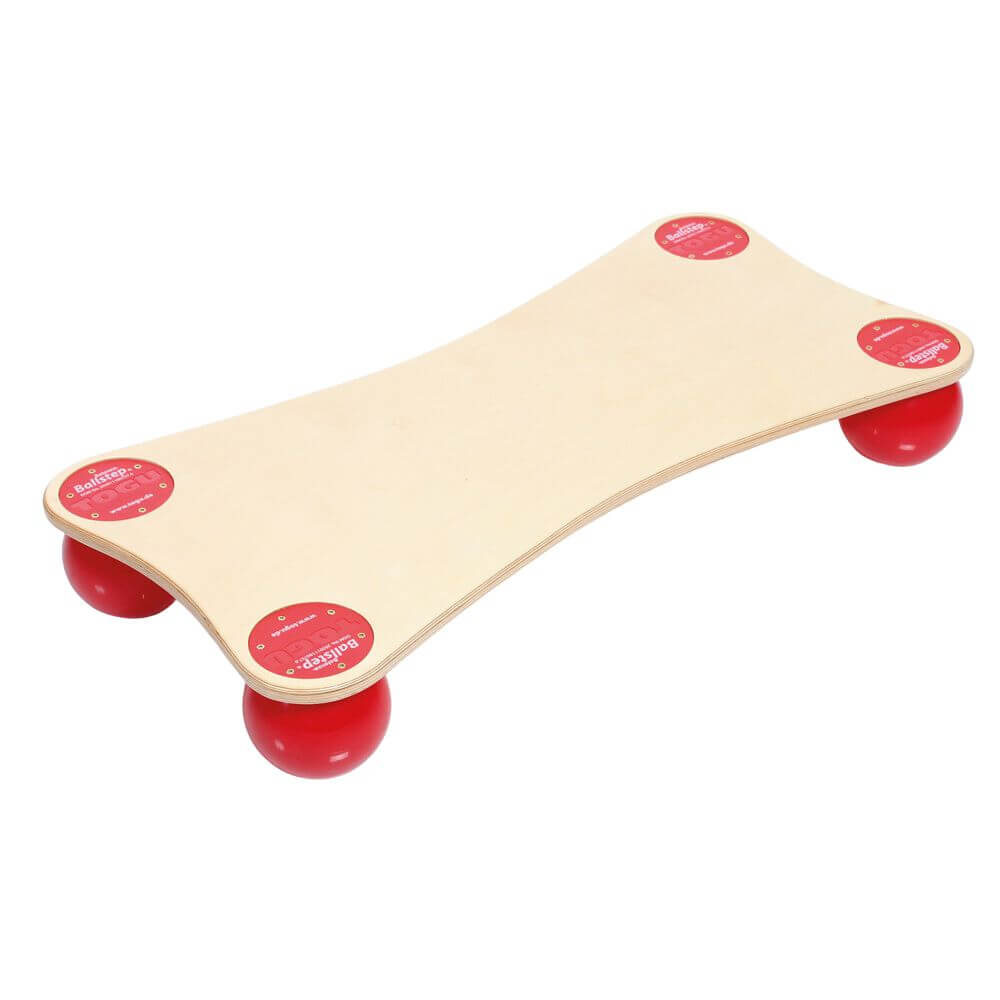
In the following we will show you some exercises on the Balanza Ballstep that are a bit more unusual and interesting for runners. Do each exercise between 10-20 seconds and then switch sides. You can increase the level of difficulty, for example, by closing your eyes while doing the exercises.
Part 1:
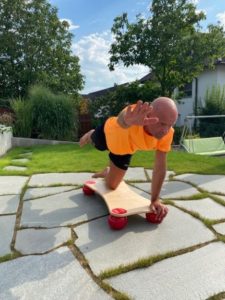
Superman or Superwoman:
This exercise is certainly known by many. You do the quadruped stance and then stretch out your left arm and right leg. This exercise is very good for the back. We make Superman or Superwoman out of it. We stretch out both the right arm and the right leg. Just hold this position for a few seconds and then switch sides.

Standing scale:
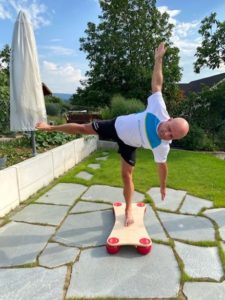
Here simply make a standing scale on the Balanza Ballstep. Try to bend your knee. It is more difficult if you do it from the side. This will stabilize the ankle and knee and strengthen the back.

Part 2:
Bending from the standing scale:
Standing scale on the left leg and then try to bend down while grabbing the right foot with the left hand. Straighten up again and change the standing leg. Here the ankle joint has to compensate a lot which leads to a great injury prophylaxis e.g. when bending over.
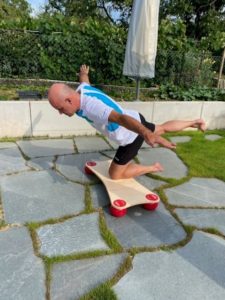
Standing scale on the knee:
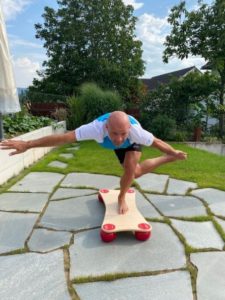
Try to kneel on the Balanza Ballstep and form a scale. Change leg. The back and hips have to do a lot of work here and are strengthened.
Part 3:
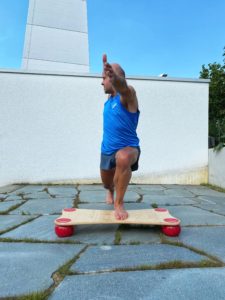
Yoga elements on the Balance Board:
Starting position is the looking down dog. Then one leg is pulled forward on the board into the lunge. Straighten the upper body and balance the stand. Afterwards, rotate left and right and return to the starting position. Leg change. This not only trains the deeper lying muscles, but also the mobility of the back and hip flexor.


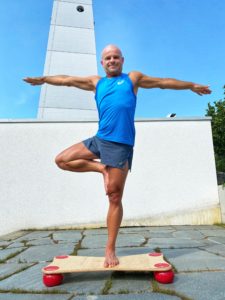
Another element from yoga, the tree. Here too, the rotational movement can be performed in both directions.

Part 4:
Walk into the inverted quadruped position and lift the leg. This activates the ankle joint as well as the tree muscles, the rear leg muscles and also the back.

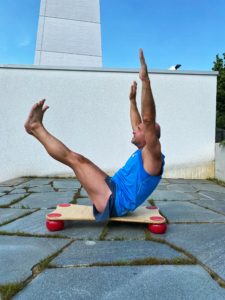
The “jackknife” is also a proven exercise that strengthens and reinforces the trunk. This exercise puts a lot of strain on the abdominal muscles, both when lifting the legs and when balancing the movement.
Part 5:
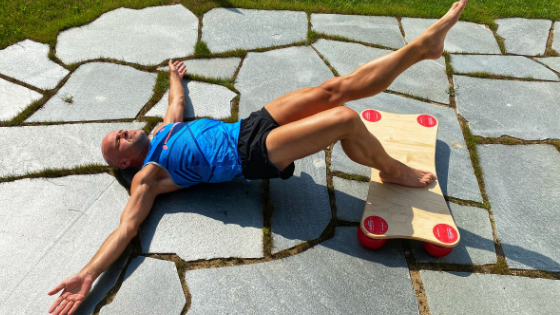
The last part is a classical exercise to strengthen the back of the legs and the abdominal muscles. Place both legs on the balance board, lift buttocks from the floor and then extend one leg and then the other, pull it up, lift it up.


With the Balanza Ballstep there are many possibilities available. You can simply try out what’s fun, bounce and jump from one leg to the other, discover new exercises yourself, vary them, increase the level of difficulty or make exercises last longer.
Use these exercises as a strengthening for your body, as a change from running training, for fun or as a challenge with your running partners.
Stay healthy and fit.
Your Franky
SPORT education/events
Frank Bauknecht, Mörikestraße 1, 72663 Großbettlingen, www.sport-education.de

-
 Bewegungsspiele für drinnen: So toben Kinder fröhlich durch den HerbstHalb fünf, draußen nieselt es, und im Wohnzimmer klettert jemand zum dritten Mal über die Sofalehne. Mit der Zeitumstellung am 25. Oktober wird es noch früher dunkel, und der Spielplatz rückt für viele Familien in die Ferne. Die Energie der Kinder bleibt. Sie braucht nur einen neuen Ort.Mehr lesen
 -
 Equestrian fitness is much more than just a traditional full-body workoutRider fitness is much more than a traditional full-body workout. This highly effective fitness course, specifically designed to meet the needs of riders, focuses precisely on the areas where stability, mobility and subtle aids in the saddle originate. Instead of conventional one-size-fits-all workouts, the focus is on targeted exercises for the shoulder girdle, back and deep core muscles, pelvic floor, diaphragm and respiratory muscles, as well as the stabilising muscles around the pelvis and hips.Mehr lesen
 -
 70 Years of TOGU – Seven Decades of Ball Manufacturing by Lake ChiemseeHow two brothers in Prien-Bachham by Lake Chiemsee developed the first seamless play ball in 1956 – and turned it into a family business that is now run by the third generation and inspires movement around the world.Mehr lesen
 -
 Neurofitness: Why Training Your Brain May Be One of the Smartest Investments in Healthy AgingWhen people think about fitness, they usually focus on muscles, strength, or endurance. But every movement we make starts somewhere else first: the brain.Mehr lesen
 -
 Balance Can Be Trained – And It’s More Important Than EverWhen people think of balance training, they often associate it with older adults or rehabilitation programs. In reality, balance is a fundamental component of nearly every movement we make—regardless of age.Mehr lesen
 -
 Why Muscle Strength Is a Key Biomarker for Healthy AgingFor many years, blood pressure and cholesterol levels were considered some of the most important indicators of overall health. Today, however, research is increasingly highlighting another powerful predictor of healthy aging: muscle strength.Mehr lesen
 -
 Longevity Starts with Movement – Why Strength and Balance Are Essential for Healthy AgingMore and more people want not only to live longer but also to remain healthy, active, and independent for as long as possible. This is the core idea behind longevity: it is not just about extending lifespan, but about increasing our healthspan—the years in which we maintain physical and mental well-being.Mehr lesen
 -
 A day full of activity, learning, and hands-on experienceSpecialist Workshop: Movement Competence in Canine Therapy – Holistic Concepts for Rehabilitation, Training, and Sustainable Performance on 29.04.2026Mehr lesen
 -
 TOGU Medicine Ball Classic: The Athletic Tool for athletesMore power, more control – why the TOGU Medicine Ball is a must-have in athletic training You train hard. You want results. And you know that the right tools make all the difference. The TOGU Medicine Ball Klassik is no nostalgic relic from the gym class era – it's one of the most effective pieces of equipment for explosive strength training, coordination, and functional athleticism.Mehr lesen
 -
 Unter der Lupe: TOGU® Brasil - mehr als nur ein FitnessbegleiterHeute testen wir für Euch die TOGU® Brasil. Ihr kennt diese kleinen stacheligen Kiwi-großen, mit Gewicht gefüllten Dinger vielleicht aus dem Fitness-Bereich oder aus dem Rückentraining. Aber diese kleinen Brasil lassen sich auch wunderbar in der Psychomotorik einsetzten, das möchten wir Euch heute gerne aufzeigen.Mehr lesen
 -
 TOGU: Moving Together for Health Day 2026 – Inspiration, exercise, and powerful motivation for an active lifestyleMovement connects, inspires, and creates new energy – that is exactly what the TOGU Together for Healthy Movement Day 2026 is all about on Saturday, October 17, 2026 in the Priental Hall in Aschau im Chiemgau.Mehr lesen
 -
 TOGU at therapie MÜNCHEN 2026The therapy MÜNCHEN 2026 brings together the therapy industry from Southern Germany, Austria and Switzerland on 19 and 20 June 2026 and sets important impulses for practice, training and rehabilitation.Mehr lesen